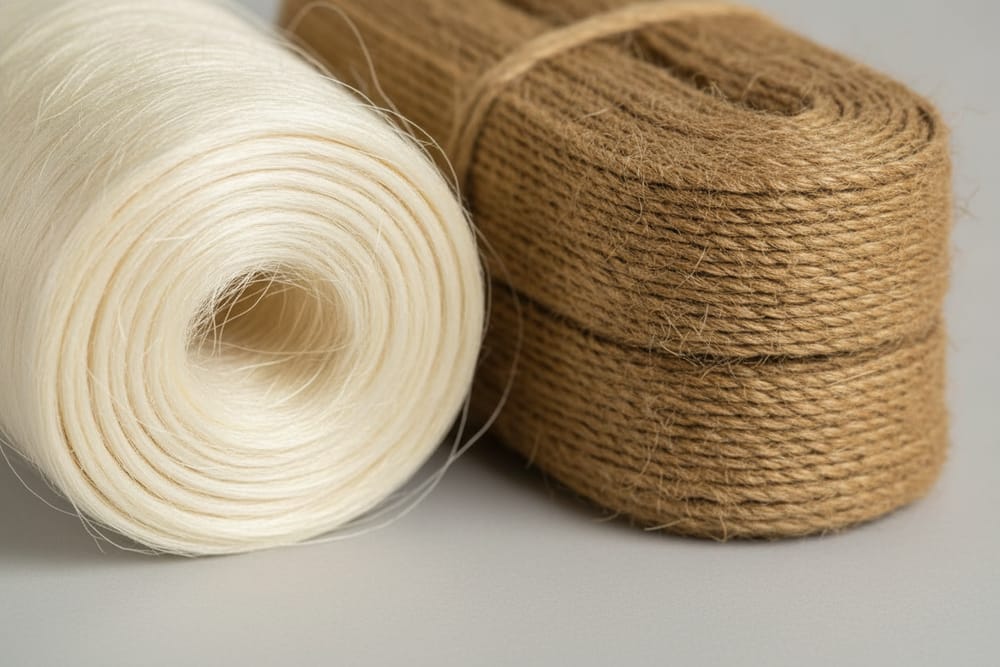
Both are natural bast/leaf fibers from South Asia — but they behave very differently. Here is how banana fiber and jute compare.
Strength and durability
Banana fiber has a high tensile strength — typically in the 500–900 MPa range — with a cellulose content of 60–65%, which is why it is used in cordage and composite reinforcement. Jute is strong but generally coarser and degrades faster when exposed to moisture.
For applications that demand long service life or contact with water, banana fiber usually outlasts jute.
Texture and appearance
Banana fiber has a natural silk-like luster and a finer hand, so it can be spun into "banana silk" for fine textiles, sarees and blended garments. Jute is rougher and is better suited to sacking, twine and hessian.
If the end product is seen or worn, banana fiber's sheen is a clear advantage.
Sustainability
Both fibers are biodegradable and renewable, but banana fiber has a standout advantage: it is harvested from the banana pseudostem, an agricultural by-product that is normally discarded after harvest. That makes it a true zero-waste, no-extra-land crop. Jute is grown as a dedicated crop that uses land, water and inputs.
For brands building a sustainability story, banana fiber's "waste-to-resource" origin is compelling.
Cost
Jute is generally the cheaper of the two because it is mass-produced at scale. Banana fiber sits at a premium for textile grades but is competitive at industrial grade — and it often delivers better value where strength, water resistance or appearance matter.
The verdict
Choose jute for low-cost bulk sacking and twine. Choose banana fiber when you need strength, water resistance, a finer texture, or a stronger sustainability narrative. For many buyers, banana fiber is the premium upgrade to jute.
Looking to buy banana fiber?
EcoFiber BD supplies premium raw banana fiber — Grade A, B & C — from Bangladesh. Request a quotation or a sample.