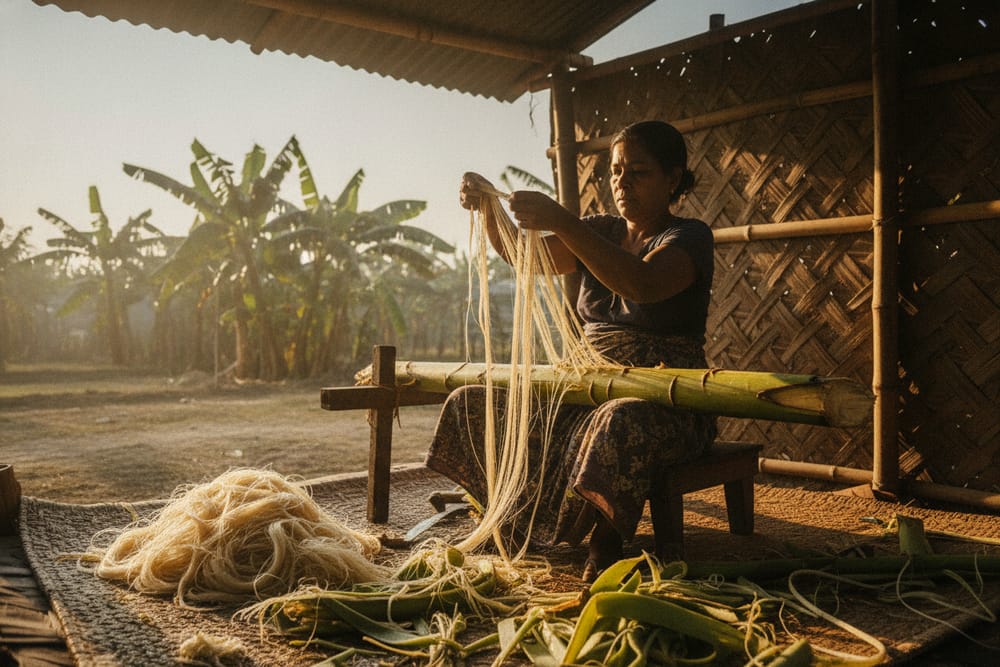
Banana fiber comes from a part of the plant most farms throw away. Here is how the pseudostem becomes usable fiber.
1. Harvesting the pseudostem
After a banana plant fruits, its trunk-like pseudostem is cut down and would normally be discarded. This by-product is the raw material for banana fiber — no extra land, water or fertilizer is needed to grow it.
2. Extraction (decortication)
The pseudostem is separated into layers, and the fibrous strands are extracted either by hand or with a decorticating machine that scrapes away the pulp. The outer sheaths yield coarser fiber; the inner layers yield the finest, most lustrous fiber.
3. Washing and sun-drying
Extracted fiber is washed to remove sap and residue, then sun-dried. Proper drying brings moisture down to a stable 10–13%, preserving the fiber's natural sheen and preventing mildew.
4. Grading and sorting
Dried fiber is sorted by length and quality into grades. Long, clean, lustrous strands become Grade A for textiles; medium strands become Grade B for handicrafts and furnishings; shorter strands become Grade C for rope and industrial use.
5. Spinning and end use
Graded fiber is baled for shipment, then spun into yarn or used directly. Depending on grade it becomes banana-silk fabric, paper, rope, mats, bags or biocomposite reinforcement.
Because the whole process starts from agricultural waste, banana fiber is one of the most sustainable natural fibers available.
Looking to buy banana fiber?
EcoFiber BD supplies premium raw banana fiber — Grade A, B & C — from Bangladesh. Request a quotation or a sample.